
INTRODUCTION
You have completed a digital marketing course. You have earned certifications from Google, HubSpot, or Meta. You have updated your resume and started applying for jobs. But after sending dozens of applications, you still haven’t received interview calls.
If this sounds familiar, you’re not alone.
Thousands of fresh graduates and career switchers face the same challenge every year. The problem isn’t always a lack of qualifications—it’s a lack of proof. Recruiters don’t just want to know what you’ve learned; they want to see what you’ve done.
That is where a digital marketing portfolio becomes your biggest advantage.
A well-structured portfolio showcases your practical skills, creativity, and ability to solve real marketing problems. It gives employers confidence that you can contribute from day one, even if you don’t have prior work experience.

Imagine two candidates applying for the same role:
- Candidate A submits a resume with several certifications.
- Candidate B submits a resume along with SEO audit reports, Google Ads campaigns, blog articles, social media strategies, and Google Analytics dashboards.
Most employers will choose Candidate B because the portfolio demonstrates real-world application, not just theoretical knowledge.
Whether you’re a student, fresher, freelancer, or career changer, building a professional portfolio can significantly improve your chances of getting shortlisted for interviews.
In this complete guide, you’ll learn what recruiters expect, which projects to include, the best tools to use, common mistakes to avoid, and how to create a portfolio that helps you stand out in today’s competitive job market.
WHY EVERY DIGITAL MARKETER NEEDS A PORTFOLIO IN 2026
The hiring process for digital marketing has changed dramatically. Employers no longer rely only on degrees or certificates when selecting candidates. Instead, they prioritize practical skills, problem-solving abilities, and measurable results.
A digital marketing portfolio provides evidence of your capabilities. It demonstrates how you approach campaigns, optimize websites, analyze data, and create engaging content. Unlike a resume, which lists your qualifications, a portfolio tells the story behind your work.
Recruiters often receive hundreds of applications for a single position. They don’t have time to evaluate every candidate in depth. A clear and well-organized portfolio helps them quickly understand your strengths and decide whether you’re a good fit.
A professional portfolio can help you:
- Build credibility with recruiters.
- Showcase real-world projects.
- Demonstrate technical skills.
- Highlight creativity and analytical thinking.
- Differentiate yourself from other applicants.
- Increase your chances of securing interviews.
Alt Text
Digital marketing fresher presenting a professional portfolio with SEO reports, Google Ads campaigns, Google Analytics dashboard, and social media marketing results during a job interview in a modern corporate office.
WHAT RECRUITERS ACTUALLY LOOK FOR IN A DIGITAL MARKETING PORTFOLIO
One of the biggest misconceptions among freshers is that earning multiple certifications is enough to secure a digital marketing job. While certifications demonstrate your willingness to learn, they rarely convince recruiters that you can handle real business challenges. Employers want evidence of practical skills, strategic thinking, and measurable results.
In 2026, hiring managers spend less than two minutes reviewing a candidate’s portfolio before deciding whether to move forward. During that short time, your portfolio must clearly answer three questions:
- Can this candidate solve real marketing problems?
- Do they understand industry-standard tools?
- Can they deliver measurable business results?
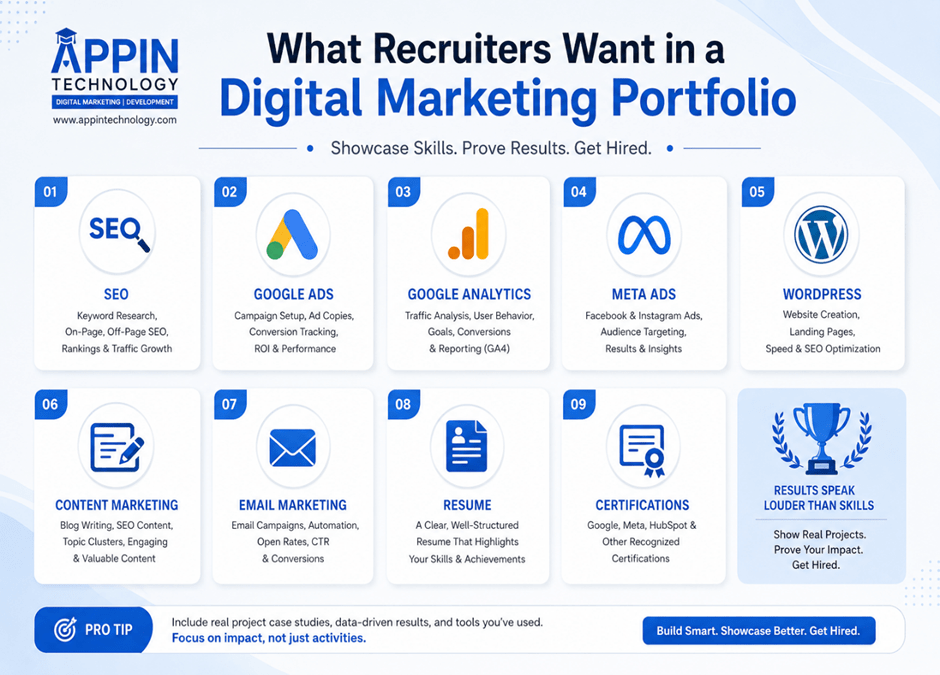
A professional portfolio should tell a story rather than simply displaying screenshots. Every project should explain the objective, the strategy used, the tools involved, and the outcome achieved. Even if you created a project for learning purposes, presenting it as a structured case study makes it valuable.
If you are currently learning through a Digital Marketing Course in Coimbatore, include every live assignment, campaign, and website optimization exercise in your portfolio. Practical projects completed during training are often more valuable than theoretical certificates because they demonstrate your ability to apply what you have learned.
10 ESSENTIAL PROJECTS EVERY DIGITAL MARKETING PORTFOLIO SHOULD INCLUDE
One of the biggest reasons freshers fail to get shortlisted for digital marketing interviews is that their portfolio contains only certificates and no practical work. Recruiters understand that you may not have full-time job experience, but they expect you to demonstrate your ability through projects.
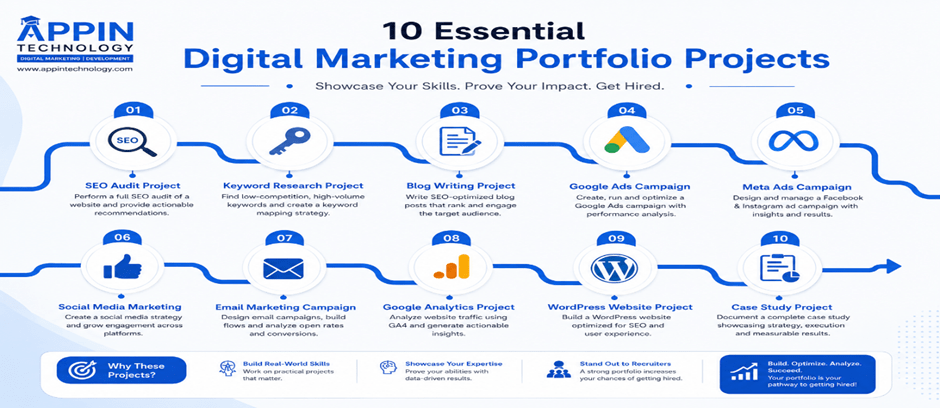
The good news is that you don’t need a client to build a professional portfolio. Many successful digital marketers landed their first job by creating personal projects, optimizing websites, writing blogs, running practice ad campaigns, and documenting the results.
If you are enrolled in a Digital Marketing Course in Coimbatore, make it a habit to save every assignment, campaign, and live project. These projects become the foundation of your portfolio and demonstrate your practical expertise to employers.
Below are the ten projects every fresher should include in their digital marketing portfolio.
SECTION 5 — HOW TO STRUCTURE YOUR DIGITAL MARKETING PORTFOLIO LIKE A PROFESSIONAL
Imagine you are a recruiter reviewing 100 digital marketing portfolios in a single day. Which one would leave a lasting impression?
Certainly not the portfolio with random screenshots, poorly organized folders, or certificates uploaded without explanation.
Recruiters value portfolios that are clean, professional, and easy to navigate. A well-structured portfolio demonstrates not only your technical expertise but also your communication, organization, and attention to detail.
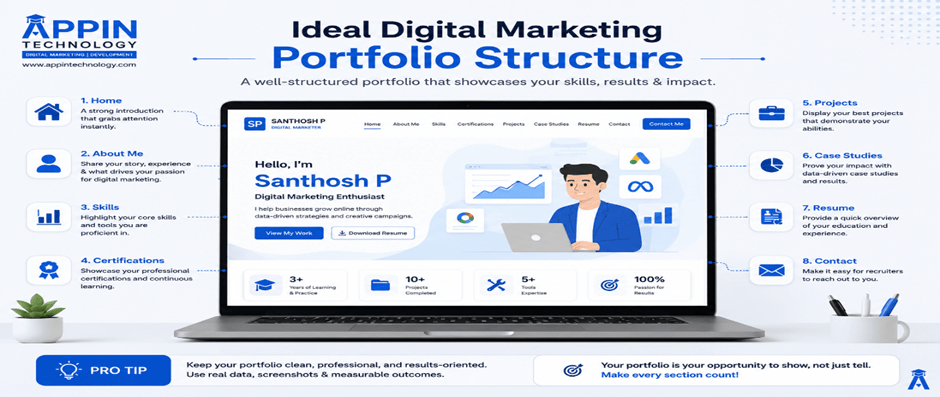
Your portfolio should tell a story—from who you are to the results you have achieved. Every page should help employers understand your skills, your approach to solving marketing challenges, and your readiness for the workplace.
Whether you build your portfolio as a personal website, a PDF presentation, or a Notion page, the structure should remain consistent.
If you are pursuing a Digital Marketing Course in Coimbatore, start organizing your portfolio from your first live project instead of waiting until the course ends. Building your portfolio gradually saves time and allows you to continuously improve it.
BEST FREE TOOLS TO BUILD A PROFESSIONAL DIGITAL MARKETING PORTFOLIO
A digital marketing portfolio is only as strong as the projects and tools behind it. Recruiters don’t expect freshers to master every premium platform, but they do expect familiarity with the tools used by digital marketing agencies, startups, and businesses.
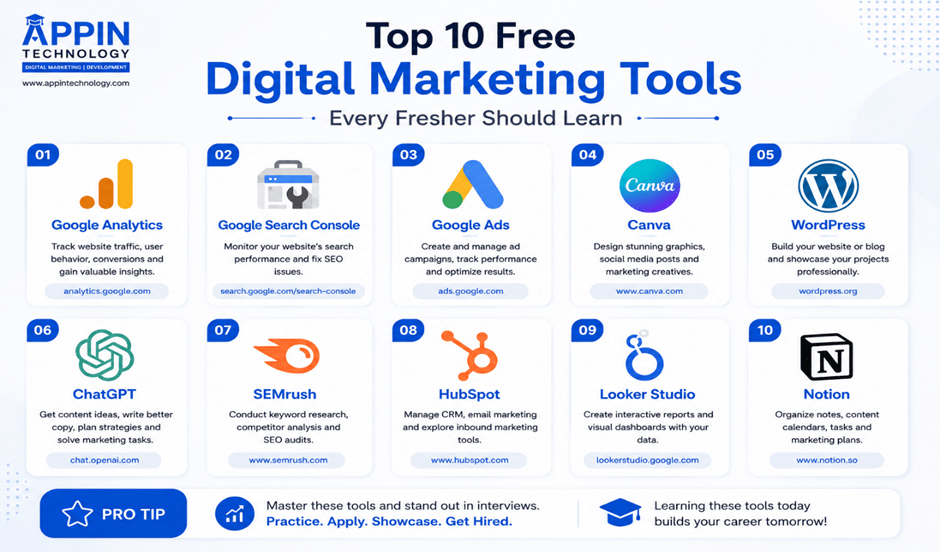
The good news is that many of these tools offer free versions or learning resources. By using them in your projects, you can build a portfolio that reflects real-world digital marketing practices without spending a fortune.
If you’re enrolled in a Digital Marketing Course in Coimbatore, you’ll typically gain hands-on experience with these tools through live projects, making it easier to showcase practical skills in your portfolio.
7 COMMON DIGITAL MARKETING PORTFOLIO MISTAKES THAT STOP FRESHERS FROM GETTING HIRED
Many freshers spend weeks creating a digital marketing portfolio, but still fail to receive interview calls. The reason is not always a lack of knowledge—it is often because their portfolio does not demonstrate the skills recruiters are looking for.
Hiring managers review hundreds of applications every month. They can quickly identify portfolios that have been copied from templates or filled with certificates but lack practical work. A professional portfolio should communicate your ability to solve real business challenges, not simply list the topics you have studied.
If you are building your portfolio while completing a Digital Marketing Course in Coimbatore, avoid these common mistakes from the beginning. A well-structured portfolio with genuine projects will always perform better than one filled with generic content.
30-DAY DIGITAL MARKETING PORTFOLIO ROADMAP TO GET HIRED
Many freshers postpone building their portfolio because they think they need years of experience. The truth is, you can create a professional digital marketing portfolio in just 30 days if you follow a structured plan.
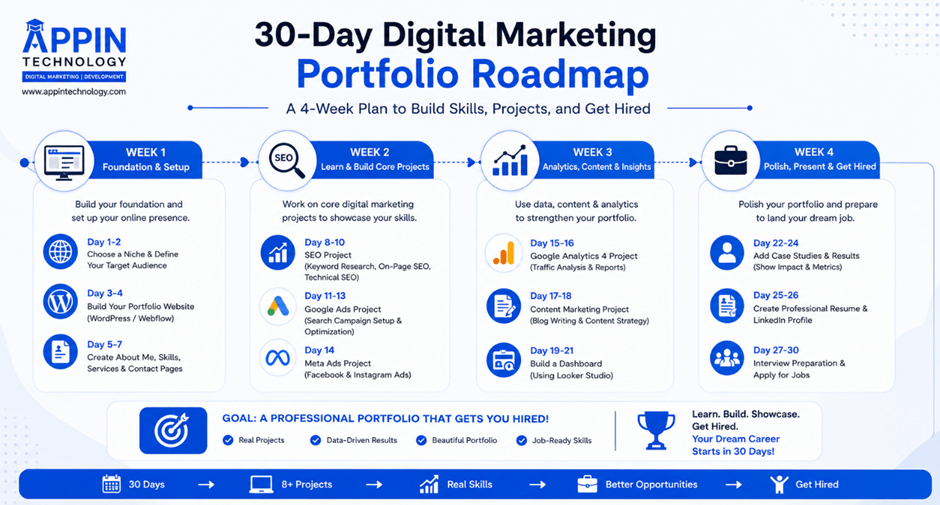
The secret is consistency. Instead of trying to complete everything in one week, focus on one important skill at a time. By the end of the month, you’ll have a portfolio with real projects, practical experience, and enough confidence to apply for digital marketing jobs.
If you’re enrolled in a Digital Marketing Course in Coimbatore, you can use your classroom assignments, internship work, and live projects to complete this roadmap even faster.
WHY CHOOSE APPIN TECHNOLOGY TO BUILD YOUR DIGITAL MARKETING PORTFOLIO?
Learning digital marketing is only the first step. The real challenge begins when you start applying for jobs. Many students complete online courses and collect certificates, but they struggle to answer practical interview questions because they have never worked on real campaigns.
At Appin Technology, Coimbatore, the focus is not just on teaching digital marketing concepts—it is on helping students become job-ready professionals with a portfolio that demonstrates real skills.
Instead of graduating with only theoretical knowledge, students work on live projects, build professional websites, optimize SEO campaigns, create Google Ads and Meta Ads campaigns, analyze performance reports, and document their work as portfolio case studies.
This practical approach helps students confidently attend interviews and demonstrate their ability to solve real business problems.
CONCLUSION
Building a professional digital marketing portfolio is one of the smartest investments you can make in your career. In today’s competitive job market, employers want more than certificates—they want evidence that you can apply your knowledge to real marketing challenges.
By including SEO audits, Google Ads campaigns, Meta Ads strategies, WordPress websites, analytics reports, content marketing projects, and detailed case studies, you create a portfolio that demonstrates both technical expertise and strategic thinking.
Remember that your portfolio is not a one-time project. Continue updating it with new campaigns, certifications, blogs, and achievements as your skills grow.
Whether you’re a student, a fresher, a freelancer, or a career changer, a well-organized portfolio will help you stand out, build confidence, and improve your chances of securing interviews.